
Montgomery County Traffic Warrants Explained
A traffic citation starts a court process. Missing the required appearance or failing to pay after judgment can lead to a failure-to-appear order, a warrant, and notice affecting driving privileges. The cause number, citation number, case type, and issuing court control the route. Indiana State Police does not take ticket payments and directs case questions to the county court.
Montgomery County has no separate municipal court in the current state directory. Crawfordsville traffic ordinance matters are processed through Montgomery Superior Court 2 under official county-hosted ordinance material. That local route does not mean every state citation or criminal traffic case belongs there. Check the citation and court record before paying or appearing.
Montgomery County Traffic Warrant Tracks
The court track and BMV track can move at different speeds. The issuing court controls the appearance, plea, payment, warrant, and disposition. The Indiana Bureau of Motor Vehicles receives court notice and controls the related driving-privilege record. A court clearance is not always visible at BMV at once, and a BMV payment does not recall a separate court warrant.
The Indiana BMV traffic-violation page shows how failure to appear and failure to pay can affect a license.
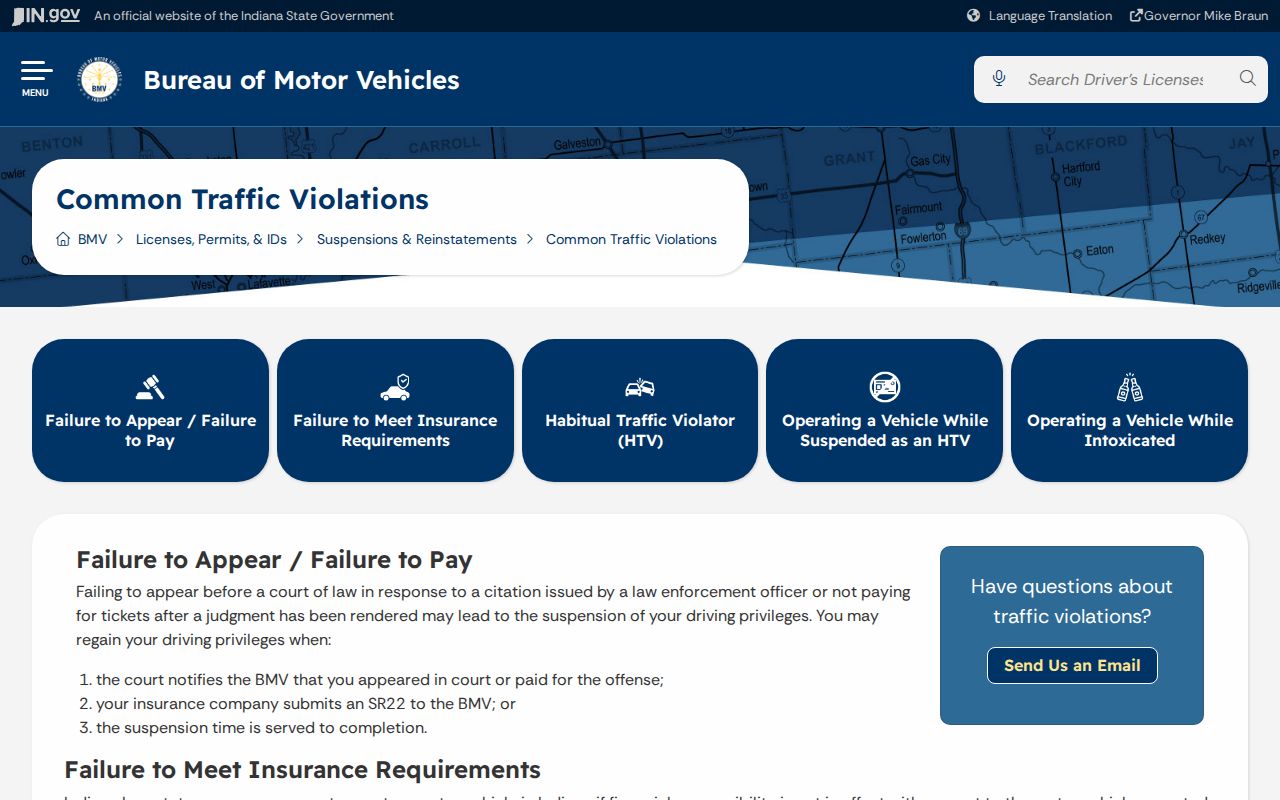
The source reinforces the key split: the court resolves the case event, while BMV processes the privilege consequence reported to it.
Checking for a Traffic Warrant
No county or city traffic-warrant portal was located. Start with MyCase, which is a public case search rather than a warrant-only database. Use exact identifiers when possible and then confirm with the court. An empty result cannot prove that no warrant exists.
- Search by citation number or cause number, then narrow the court to Montgomery County.
- If needed, use party name, date range, status, and case-type filters from the official search tools.
- Call the Montgomery County Clerk at 765-364-6430 or the court named on the citation or docket.
- Ask whether a warrant or FTA order exists, what appearance is required, and whether a judge must act.
- For sheriff service or custody instructions, call the Sheriff/Jail at 765-362-3740 before traveling.
The courthouse at 100 East Main Street handles court records. The sheriff and jail at 600 Memorial Drive handle custody and service. They are not interchangeable stops.
Crawfordsville Traffic Cases in Montgomery County
Crawfordsville is the county seat and the main overlap point for police, courts, clerk, and sheriff. Its official ordinance material routes city traffic ordinance violations through Montgomery Superior Court 2. The Crawfordsville Police Department page offers police contact and a public-record request route, but a police record is not the court's live warrant status.
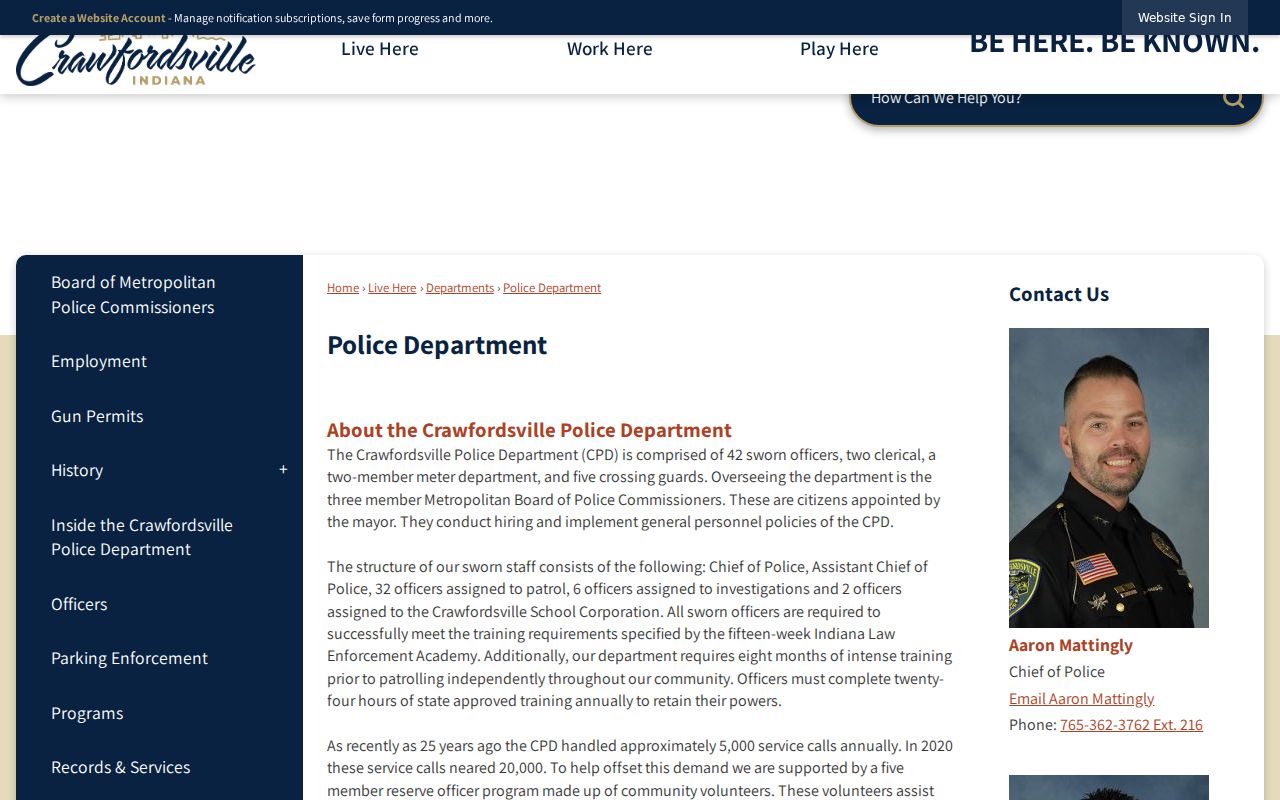
The image helps identify the investigating agency channel. A person still needs the citation, MyCase record, clerk, or Superior Court 2 for the court order itself. State citations and higher-level traffic offenses may follow another assignment, so never infer the court from the city name alone.
Inside a Traffic Warrant Record
A public case summary may show enough to identify the case and ask a precise status question. It may not display the full order, a confidential warrant, or every recent change. Save the case key and read the docket event in context.
| Citation or cause number | The main lookup key, such as the non-real sample 54D02-26-IF-000321. |
|---|---|
| Case type | Shows whether the record is an infraction, misdemeanor, ordinance, or another case category. |
| Issuing court | The court that controls the appearance, warrant, and disposition. |
| Docket event | May record an FTA, warrant, recall, payment, hearing, or later court order. |
| Financial entry | May show court costs or balances, but is not proof that a warrant is cleared. |
| Status | Open or closed case labels still require review of the actual order and obligations. |
Indiana's MyCase help warns that online entries may contain omissions or errors. The clerk holds the official court record.
Montgomery County Traffic Warrant Dates
Act before driving to a courthouse or jail. Find the citation, note the cause number, and call the issuing court. Ask whether the docket shows an FTA, warrant, bond condition, or required hearing. Staff can state procedure but cannot recommend a plea or legal strategy. An attorney can address contested charges and a motion that requires judicial action.
- FTA
- Failure to appear, meaning the required court appearance was missed and the court may issue process.
- Recall
- A court action withdrawing a warrant. Payment alone is not proof that recall occurred.
- Disposition
- The court's recorded outcome sent downstream when required.
- Indefinite suspension
- A BMV status that can remain until disposition information is received, not proof of a currently active warrant.
Keep any reset notice or disposition. It is the best evidence for later court and BMV follow-up.
How to Pay or Lift a Traffic Warrant
There is no verified Montgomery County promise that a ticket payment automatically lifts every traffic warrant. The court must determine what the case requires. Depending on the order, that may be payment, a plea, a hearing, bond, counsel, or a judge's recall. Follow the court's instructions in the sequence given.
- Confirm the issuing court, cause number, warrant or FTA status, and current required action.
- Ask whether payment is permitted or whether an appearance and court order are required.
- Complete the court step and obtain the filed disposition or recall record.
- Confirm that any required notice was sent to BMV.
- Check the BMV status and complete any separate reinstatement steps or fees.
Warning: A payment or BMV fee does not prove a Montgomery County traffic warrant has been recalled by the issuing court.
Montgomery County Traffic Warrant Proof
The BMV reinstatement instructions direct a driver back to the court for a court-ordered suspension and describe the documentation BMV needs.
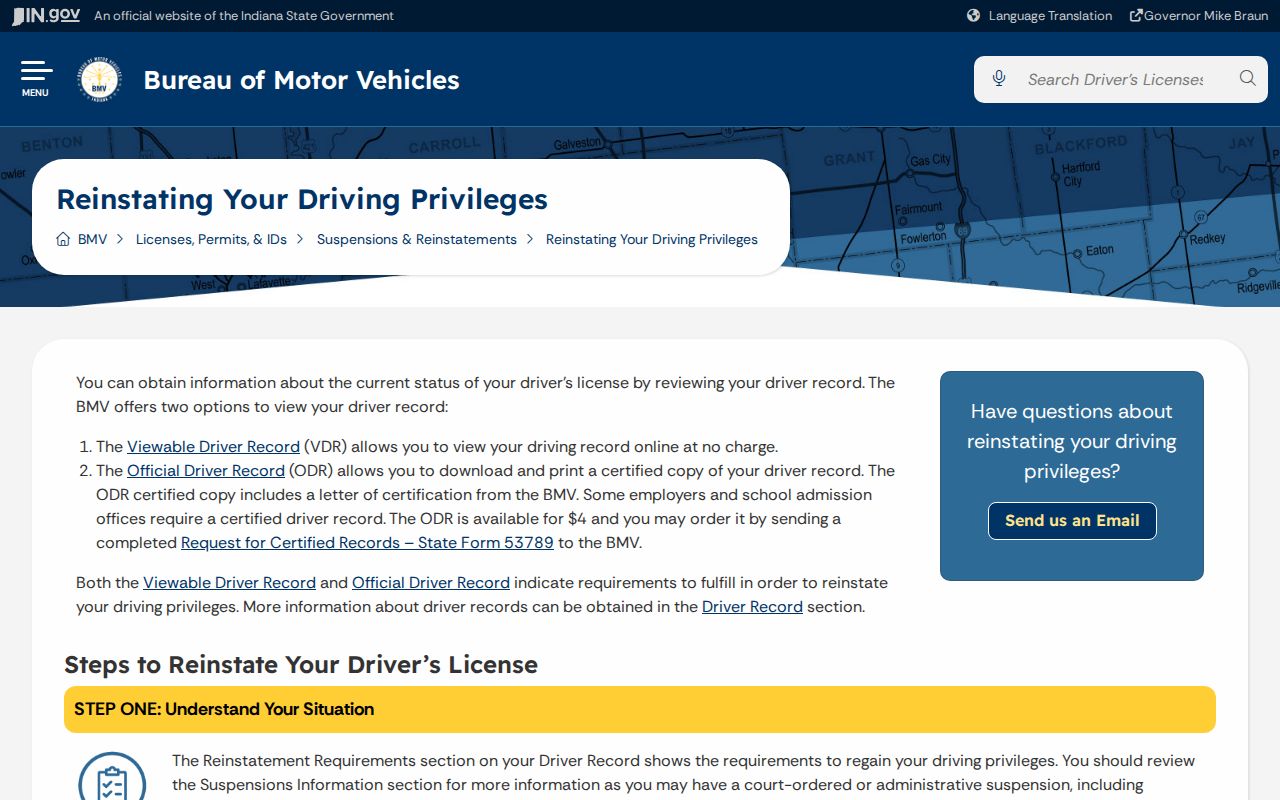
The process is evidence-based. Save the court disposition, the date it was entered, the cause number, any proof of transmission, and the later BMV confirmation. If one system still shows an unresolved event, provide that office with the matching official record. Do not use a driving record as a substitute for the court docket, and do not use a court docket as final proof of current license status.
Traffic Warrants, FTA, and License Holds
One missed citation duty can create several records. Each has a different custodian and legal effect. The phrase traffic warrant should stay tied to the court process, not be used as a loose label for everything on a BMV record.
| Mechanism | Controlled by | What it means |
|---|---|---|
| Traffic warrant | Issuing court and law enforcement | A court command subject to the actual case order |
| FTA event | Issuing court | The required appearance was missed and court action followed |
| License suspension | Indiana BMV after court notice | A driving-privilege consequence that may persist until disposition arrives |
Resolve the court matter first, then verify BMV. The Montgomery County municipal warrant route explains why local ordinance cases still lead to county courts here.
Montgomery County Traffic Warrant Closure
Ask the clerk for the docket entry or order that states what happened. Useful terms include served, recalled, quashed, reset, paid, and disposed. They have distinct meanings. A closed case label may not describe every linked obligation, while a remaining BMV flag may reflect processing lag rather than an active warrant.
If the record is missing online, request it from the Montgomery County Clerk. Police or sheriff records belong with the relevant law-enforcement agency under Indiana public-record guidance. A narrow request should name the cause number, citation number, record type, and date range. That approach is more useful than asking for every traffic warrant in the county.
Before leaving the process, keep both forms of proof: the court's official disposition and the BMV's later status confirmation. They answer different questions and help resolve a mismatch without guesswork.