
Montgomery County Municipal Court Warrants
“Municipal warrant” can be a misleading label in Montgomery County. The current Indiana court directory identifies Montgomery Circuit Court, Superior Court 1, Superior Court 2, and the Montgomery County Clerk. It does not list a Crawfordsville, Ladoga, Waynetown, Darlington, or Linden municipal court.
That negative finding changes the search. An ordinance, traffic, misdemeanor, or failure-to-appear matter linked to a city still proceeds through the county court named in the case. A city police department or town marshal may investigate, issue a citation, or serve court process, but it does not create a separate city-court record system where none exists.
Montgomery County Municipal Warrant Labels
People often use “municipal warrant” to mean any warrant tied to a city ticket or local police contact. Here, that phrase describes the local subject matter, not the name of the issuing tribunal. Crawfordsville ordinance material is the clearest example: city traffic ordinance violations route through Montgomery Superior Court 2, with the county Clerk handling related court process.
Key point: No separate municipal court or city warrant portal was found for Montgomery County; verify the county court shown on the case.
This is not a minor naming issue. Calling a town office and asking for a nonexistent court desk can delay a response. Start with the citation or cause number and identify the county court before choosing a phone number or building.
Montgomery County Cities With Municipal Courts
None of the five largest incorporated places has a separate municipal court listed in the state directory. Their local agencies still matter for police records, dispatch, service, and safety. Court warrant status remains with the county court system.
| Place | Local agency route | Court-record route |
|---|---|---|
| Crawfordsville | City Police Department | Montgomery county courts; ordinance traffic routes to Superior Court 2 |
| Ladoga | Part-time marshal and deputies; sheriff backup | Montgomery county courts and Clerk |
| Waynetown | Town marshal; county dispatch | Montgomery county courts and Clerk |
| Darlington | Local police and county dispatch | Montgomery county courts and Clerk |
| Linden | Local police with county or state backup | Montgomery county courts and Clerk |
The table separates law-enforcement contact from court custody. A police report request is not a warrant-status decision.
Montgomery County Municipal Warrant Courts
Crawfordsville has the county's densest cluster of justice services. The county courthouse at 100 East Main Street houses the Clerk and all three county courts. Crawfordsville Police is at 311 North Green Street, while the Sheriff and Jail are at 600 Memorial Drive. These locations answer different questions.
The police department page links a public-record form for police records. It does not certify the live status of a court warrant. Use the police route for releasable incident or agency material. Use MyCase, the Clerk, or issuing county court for the order, court date, warrant recall, and case status. Use the sheriff or jail for service and custody instructions.
Checking a Municipal Court Warrant
The strongest search uses a cause number or citation number. Indiana MyCase may show a warrant or FTA event in a public case summary, but it has no warrant-only function and cannot search every warrant in Indiana. No local city portal fills that gap.
- Search MyCase by cause or citation number and narrow the court to Montgomery County.
- If no number is known, search by party name, date range, status, and likely case type.
- Call the Montgomery County Clerk at 765-364-6430 to identify the issuing court or request the official file.
- Contact Circuit Court at 765-364-6450, Superior Court 1 at 765-364-6447, or Superior Court 2 at 765-364-6455 as the case directs.
- For service, custody, or surrender routing, call the Sheriff/Jail at 765-362-3740 before appearing.
For releasable sheriff records, the official records email is dell.wilson@montgomerycounty.in.gov. A narrow request should state the cause number, record type, and date range.
Montgomery County Municipal Warrant Routing
Ladoga's official services page describes one part-time marshal and three deputies with limited weekly coverage. The Montgomery County Sheriff dispatches help when local coverage is unavailable. Waynetown tells residents to use Montgomery County Dispatch for non-emergency service because the nearest on-duty officer may respond. Linden also documents county or state backup.
Those facts explain operations, not court creation. A town marshal can respond to a call or act on valid process, yet the warrant still traces back to a Montgomery County court. The Ladoga services page illustrates that shared model.
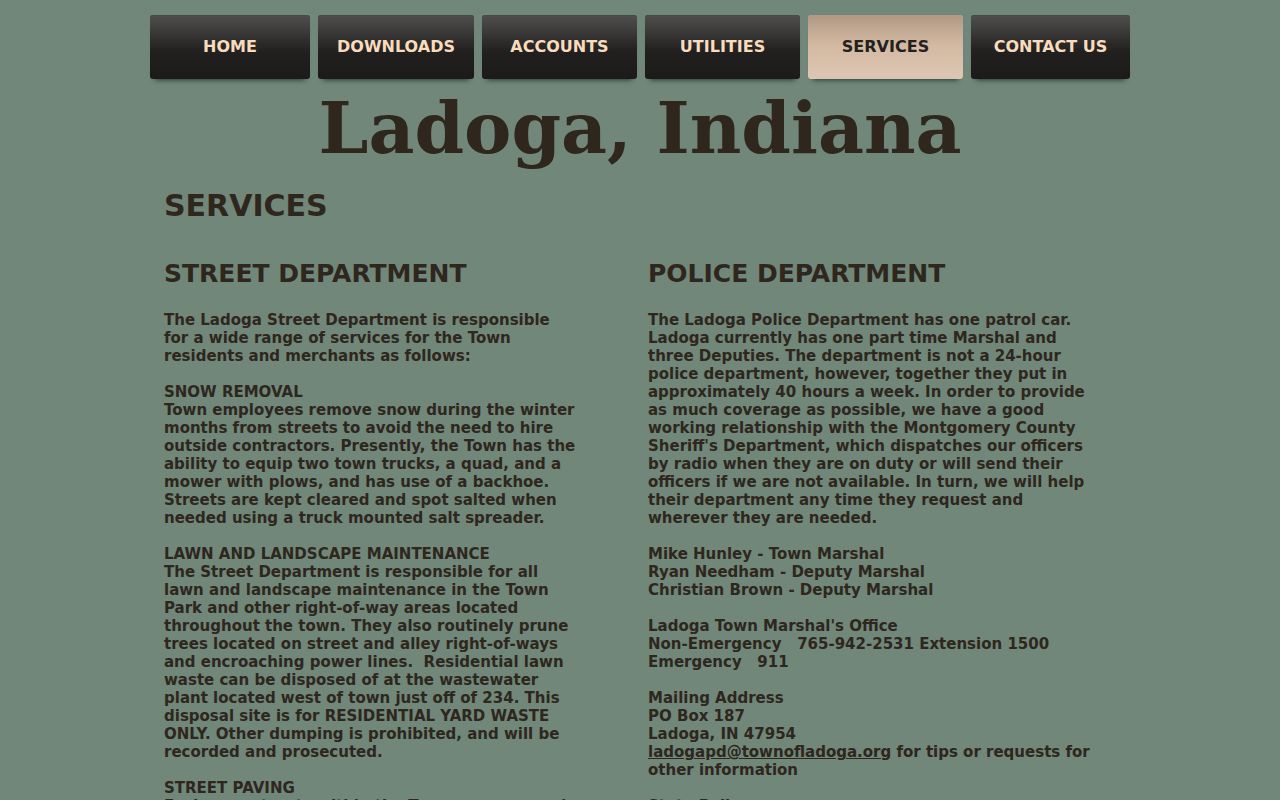
The Ladoga source confirms why county dispatch and the county court route matter when local coverage is part time.
The Darlington Police page separately publishes local police, county dispatch, and sheriff tip contacts.
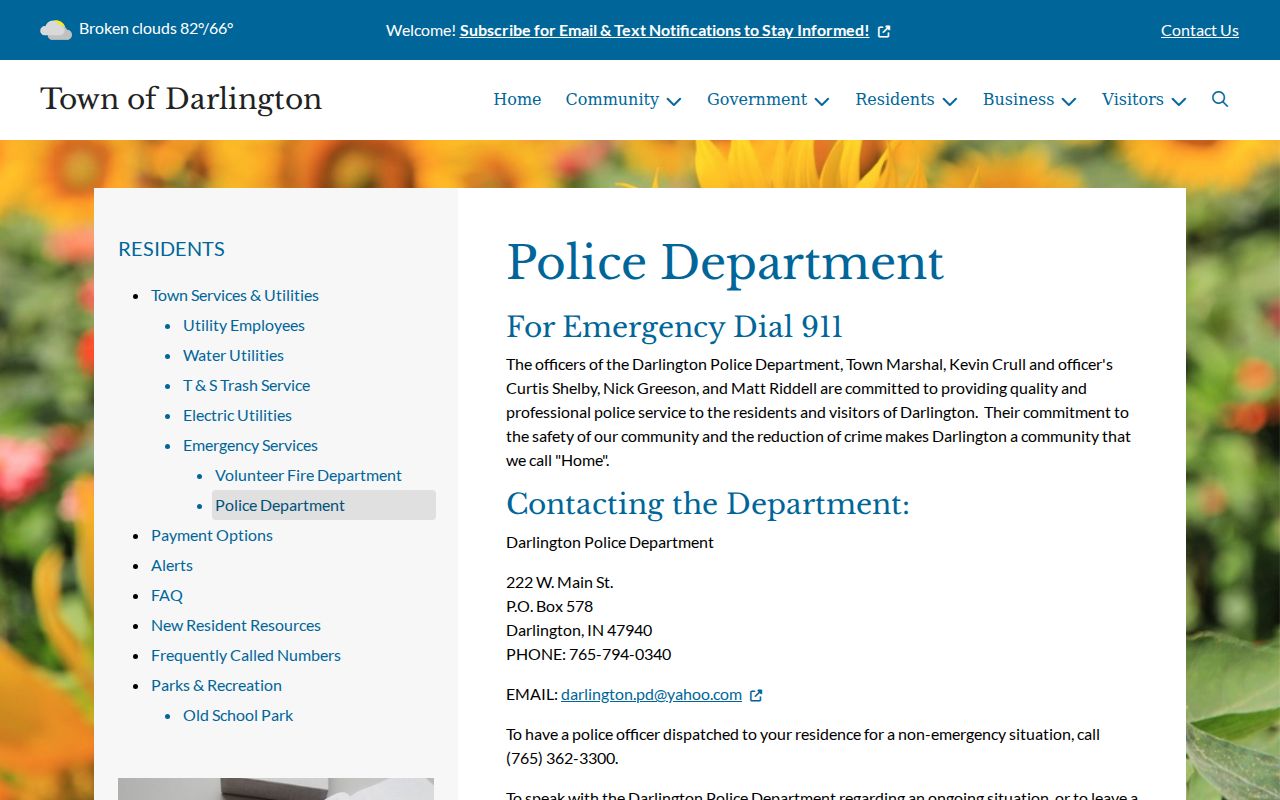
That contact block shows three distinct channels. None is evidence of a separate Darlington municipal court or a live warrant database.
- Town marshal
- A local law-enforcement officer, not a municipal court.
- County dispatch
- The communications route that sends an available officer.
- Issuing court
- The county court that signed and controls the warrant order.
- Clerk
- The official custodian for the county court file and filings.
Inside a Municipal Court Warrant
A public record should be read by fields, not by the casual “municipal” label. The cause number identifies the county court and case type. The docket may show a citation, missed appearance, warrant event, bond term, recall, or later disposition. Some documents can be confidential, sealed, expunged, excluded, or unavailable online.
| Cause or citation number | The search key, such as the fictional sample 54D02-26-IF-000654. |
|---|---|
| Case type | Identifies ordinance, infraction, misdemeanor, felony, or another county case category. |
| Issuing court | Circuit, Superior 1, or Superior 2, not a separate city court. |
| Event | May state FTA, warrant issuance, service, recall, hearing, or disposition. |
| Bond or terms | Only the current order controls; a schedule is not a guaranteed amount. |
| Status date | Shows when an event was entered, which may differ from when another system updates. |
Ask the Clerk for the official record when a MyCase line is incomplete or unclear.
Montgomery County Municipal Warrant Records
City police and town agencies may hold incident reports, citations, or service records. The county Clerk holds court filings. The judge controls the warrant. The Sheriff handles county law enforcement, jail, transport, and service functions. Each record route can be valid while answering a different question.
A request to a city police department should not ask that agency to certify what only the court can decide. Likewise, the Clerk may not hold every police investigative record. Indiana Judicial Branch request guidance separates court records from criminal or police records. Use that split when a city-linked case has both kinds of material.
Absence from a sheriff list also proves nothing. Montgomery County publishes no complete active-warrant database, and the Most Wanted page is only a selected program.
How to Resolve a Municipal Court Warrant
Resolution happens through the county court that issued the order. Do not assume a city payment, a police call, or a jail visit cancels the warrant. Montgomery local rules make judicial action important after some failures to appear, and the actual case order may require counsel, a hearing, bond, surrender, or another step.
- Confirm the cause number, county court, warrant type, and current status.
- Ask the Clerk or court whether payment is allowed or a judge must act.
- Speak with an attorney when a motion, plea, or planned surrender is involved.
- Follow the court's appearance, bond, or filing instructions.
- Obtain the order showing recall, quash, service, or other disposition.
Warning: A city-linked payment or police contact does not clear a Montgomery County warrant unless the issuing court records that result.
Montgomery County Municipal Warrant Closure
Keep the filed court order, cause number, date, and court name. Recall means the court withdrew the warrant. Quash means it formally set the warrant aside. Service means law enforcement carried out the command. These outcomes have different effects, so ask for the exact entry rather than a vague statement that the matter is “handled.”
If a traffic case also affected driving privileges, follow the court disposition with a separate Indiana BMV status check. The Montgomery County traffic warrant search explains that two-track process. BMV status does not replace the court record.
No verified local warrant amnesty, automatic recall program, or municipal-court walk-in schedule was found. Call the Clerk, issuing court, and Sheriff/Jail before traveling. That direct confirmation is safer than relying on an old online summary.